The Korean War: wounds and wonders of the Korean peninsula
How the Korean War (한국전쟁), which South Koreans call the 6.25 War (육이오 전쟁), began at the 38th parallel (38선), and the words that come with it: 한강, 영부인, 호주댁, 419 혁명 and the Christmas miracle at 흥남.
You have probably heard of the Korean War (한국전쟁). In South Korea we also call it the 6.25 War (육이오 전쟁), because it broke out on June 25, 1950. 육이오 is simply the digits six, two and five read out loud, the way Koreans often name a date.
There is a great deal about the war online, so I will keep to how it started, how it unfolded, and a few of the stories that explain how Koreans remember it.
I also recommend the film Ode to My Father (국제시장). It shows the war and Korea’s recent history in a way that is easy to follow. Once you have read this article, you will understand the film much better.
Before the war
On August 15, 1945, Korea became independent from Japanese colonial rule. At the end of the Second World War the United States dropped two atomic bombs on Japan, one on Hiroshima on August 6 and one on Nagasaki on August 9. Six days after Nagasaki, on August 15, Japan surrendered unconditionally to the Allies. That surrender gave Korea its independence.
Shortly before that, the Soviet army was already in the north of the peninsula. The Soviet Union had joined the war on the Allied side and wanted to disarm the Japanese forces there. So with liberation, the north of Korea came under Soviet occupation.
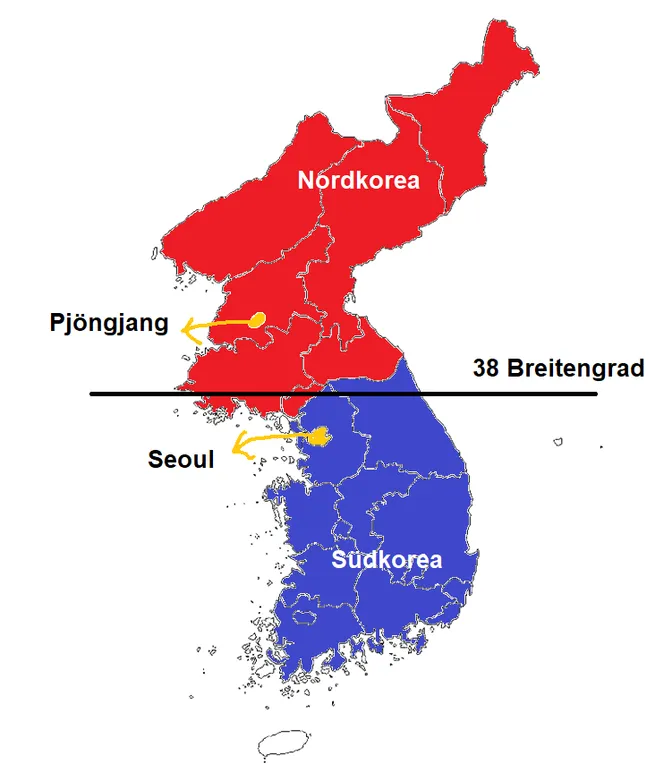
At the same time, the US military occupied the south. The two powers now faced each other across the 38th parallel (38선), Korea’s own stretch of the Iron Curtain. For about three years, Korea lived under US and Soviet military government.
The fall of Seoul
On August 15, 1948, the third anniversary of independence, the Republic of Korea was founded in the south. On September 9, the Democratic People’s Republic of Korea was founded in the north. Even before the war, there were exchanges of fire between the two sides near the 38th parallel.
June 25, 1950 was a Sunday, and a third of South Korea’s troops were on leave. At four in the morning, the North Korean army attacked without a declaration of war.
The northern troops came south from the 38th parallel with Soviet T-34 tanks. South Korea had no tanks at all. Seoul, the capital, fell in three days.
South Korea’s first president was Rhee Syngman (이승만). By the time the war began he had already left Seoul, yet on the radio he told the citizens of Seoul to stay where they were and go to work.
The Han River, Hangang (한강), flows from east to west through Seoul and divides the city into a northern and a southern half. It is one of the widest rivers in the world.
On June 28, 1950, three days into the war, President Rhee Syngman had the pedestrian bridge (인도교) blown up at 2:30 in the morning to stop the citizens from evacuating south. People who were crossing at that moment died. The citizens of Seoul were cut off from the south and had to watch as North Korean troops took the city.
The first president and Austria
A few more words about Rhee Syngman, because his story has a connection to Austria.
Rhee was the first Korean to earn a doctorate in the United States, and he became South Korea’s first president. During the Japanese colonial period he had fought for independence. Once in office, he changed the constitution so that he could be re-elected, and he was, twice.
He was elected a fourth time as well, but the rigged election set off the April 19 Revolution (419 혁명), and he stepped down. He died in Hawaii.
His wife was Franziska Donner from Vienna. They met in Geneva in 1933, where Rhee was attending a League of Nations conference. She was staying at the same hotel with her mother, and the two met in the hotel restaurant.
They married in the United States, and Franziska Donner became South Korea’s first First Lady. There were 25 years between them. Love, it seems, did not care about borders or age.
First Lady is 영부인 in Korean, but Koreans at the time called her 호주댁 instead. 호주 is Australia, and 댁 means the woman of a house. It is not an especially polite form. So 호주댁 means “the woman from Australia”.
People still mix up Austria and Australia today. Back then, naturally, even more people did.
Franziska Donner died in South Korea in 1992.
How the war unfolded
Back to the war itself.
Three days after it began, Seoul was in North Korean hands, and the North Korean army kept pushing south. Within a month, South Korea’s troops were pinned behind the Nakdong River (낙동강) line in the far south.
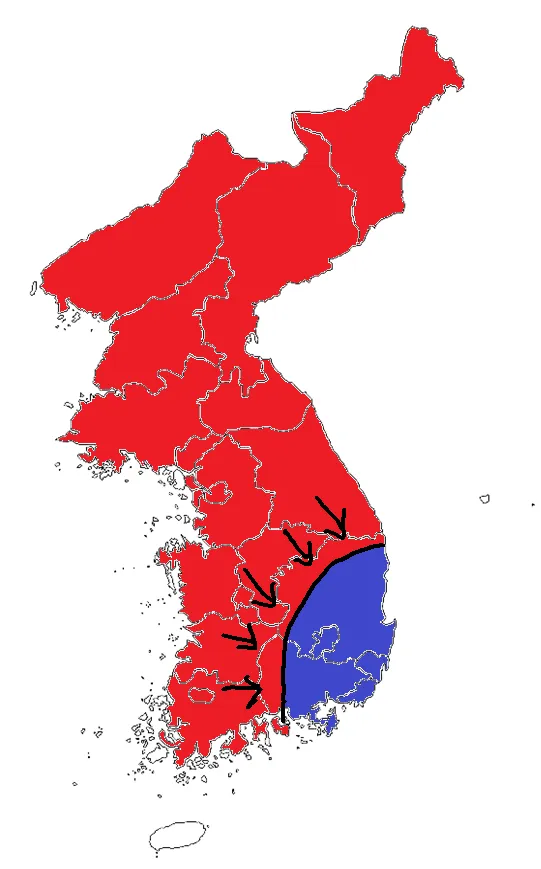
The United States convened the UN Security Council, and UN troops were sent to South Korea.
In September 1950, Douglas MacArthur arrived in Busan as commander of UN forces from 16 countries: the United States, the United Kingdom, Australia, Canada, the Netherlands, France, New Zealand, the Philippines, South Africa, Turkey, Thailand, Greece, Belgium, Luxembourg, Ethiopia and Colombia. Korea has not forgotten this. When many countries asked South Korea for help during the Covid pandemic, Korea helped Ethiopia first, a veteran of the 6.25 War.
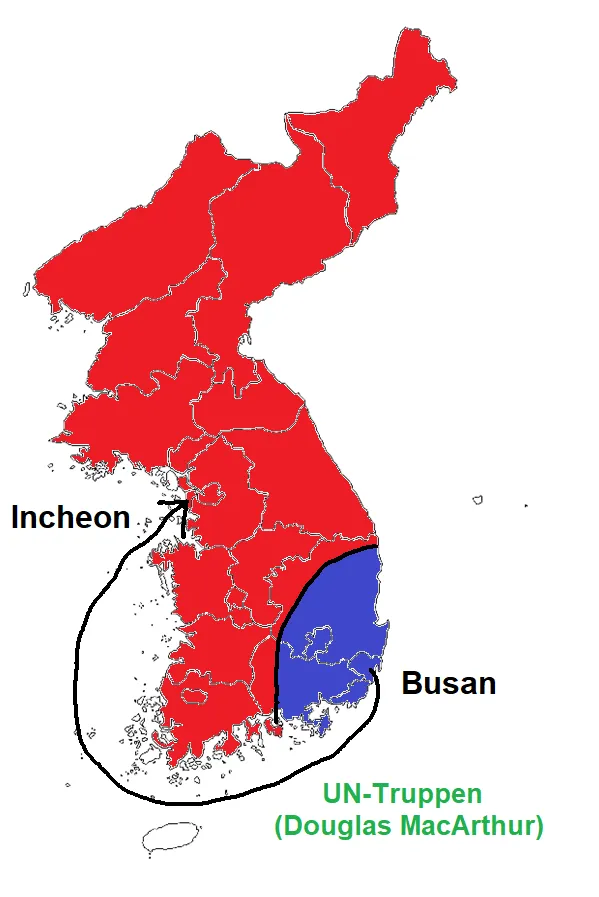
MacArthur sailed from Busan to Incheon to attack the North Korean army. If you want to know more about the Incheon landing, watch the film Operation Chromite (인천상륙작전).
On September 28, the UN troops from Incheon met the Korean troops from Busan and retook Seoul. They continued north and crossed the 38th parallel on October 1. That is why October 1 is Armed Forces Day in South Korea.
If you would like to know more about Armed Forces Day, read the article on holidays in Korea.
On October 19, the Korean army took Pyongyang (평양), the capital of North Korea, and pushed on north toward the Yalu River (압록강) and the Tumen River (두만강).
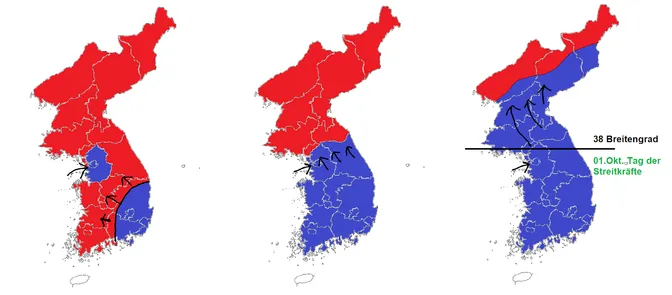
At that point, however, the Chinese Communist Party sent troops into North Korea. China had an enormous number of soldiers then, as now. It is said there were more Chinese soldiers than weapons for them. To escape the bombing, they dug tunnels, said to add up to 6,700 km in total.
The Christmas miracle and the armistice
The cold and the Chinese forces pushed the UN troops back again.
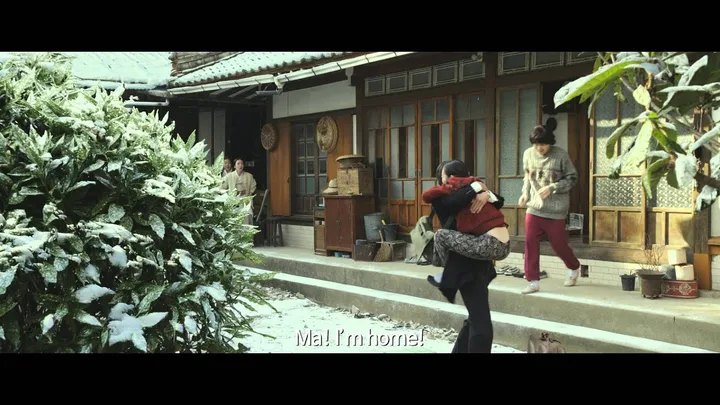
On January 4, 1951, Seoul fell to the North a second time. Before that, some UN troops, the US X Corps, had been cut off by Chinese forces at the port of Heungnam (흥남). This is the episode you see in the film.
Around 100,000 American soldiers were being evacuated by sea with 350,000 tons of ammunition. Then about 100,000 Korean refugees gathered at the port of Heungnam, hoping to leave too.
On the SS Meredith Victory, the ship at the center of this story, there was room for 60 more people, 47 of them crew. So only 13 Koreans could have boarded.
Instead, the US military threw 250,000 tons of ammunition overboard and brought 14,000 Koreans to Geoje Island by way of Busan. Then the pier at Heungnam was blown up.
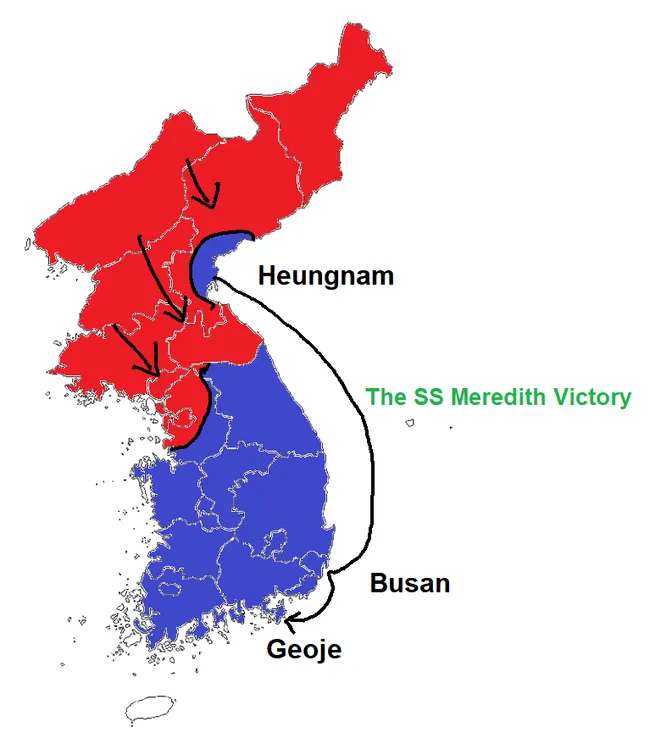
Not a single person died on the voyage, and five babies were born. The US crew named the five children Kimchi 1 to 5. The event is called the Christmas miracle, because it was around Christmas when they reached Geoje Island.
The SS Meredith Victory was the last ship carrying civilians out of Heungnam, and the rescue was entered in the Guinness Book of Records as the most successful rescue operation.
The war went on for two more years, three years and one month in all.
In 1953 came the armistice, but no peace treaty was signed. It is the longest armistice in the world. Even so, many South Koreans, myself included, do not spend their days worrying about war or threats from the North. In everyday life it feels like a political topic.
On both sides, 1.6 million soldiers were killed. In South Korea alone, 990,000 civilians died. There were 100,000 war orphans and millions of separated families.
At that time, South Korea was poorer than North Korea.
How did South Korea grow its economy?
This part, too, is told well in Ode to My Father (국제시장).
After the war, South Korea received American aid: flour, sugar, cotton and the like. In the late 1950s, that aid stopped.
From the 1960s into the 1970s, Koreans went to Germany to work as miners and as nurses.
For 500 mining jobs, 46,000 people applied. That is 92 applicants per place.
About 8,000 miners and 12,000 nurses were sent to a country 8,000 km away.
They earned money, saved it, and sent it home to South Korea.
At the time, income in South Korea was 70 US dollars per person per year. A guest worker sent home 1,200 dollars per person. Together, their money came to 2 percent of Korea’s GDP.
They helped build not only Germany’s postwar economic miracle but also the Miracle on the Han River. By the 1970s, South Korea was richer than North Korea.
Reunited families
In 1983, on the 33rd anniversary of the war, the public broadcaster KBS started a program to reunite separated families within South Korea. There were so many requests that the phone lines were useless, so people from all over the country gathered at the KBS building in Seoul.
KBS then broadcast live, every day, for 138 days. More than 100,000 people took part, and more than 10,000 families who had fled from North Korea and were living in the South found each other again.
Two years later, families from South and North Korea met in Seoul and Pyongyang. It lasted only a few days, and then they had to part again.
After the summit between South and North Korea in 2000, there were several more family reunions. Then governments changed, and relations between the two Koreas worsened again.
Getting through crises
In 1997 came the IMF currency crisis. The Korean people collected gold and paid off the national debt in three years. I remember watching it on television when I was in high school. Some people donated their gold teeth.
In 2002, the World Cup was held in Korea, and the Korean team reached the semifinals. I cannot forget how everyone came out onto the streets and cheered together.
I was a university student then and had exams to study for. The World Cup made that impossible.
In 2020 came the Covid pandemic. After China, South Korea had many early infections, but it was widely seen as one of the countries that handled the virus best.
Conclusion
Korea is like a sandwich. Because of its geopolitical position, it sits squeezed between the great powers China, Japan and Russia.
The Korean people did not want the country divided into South and North. We look forward to the day when we are reunited, because then we can get through the next crisis together.