
Learn the Korean alphabet: an introduction to Hangul
Learn Hangul in eight steps: the ten basic vowels from ㅏ to ㅣ, the fourteen basic consonants, syllable blocks like 가, 고 and 문, the silent placeholder ㅇ, double consonants (사다 and 싸다), double vowels, the final consonant batchim and the liaison rule behind 음악 → [으막].
The Korean alphabet, Hangul (한글), is the first step in learning Korean. For many learners it is also the most intimidating one. It does not need to be. Hangul is far less complicated than it looks at first glance.
We are convinced that anyone who invests just 30 minutes a day can master the Korean alphabet in two weeks. This article is your guide to learning it.
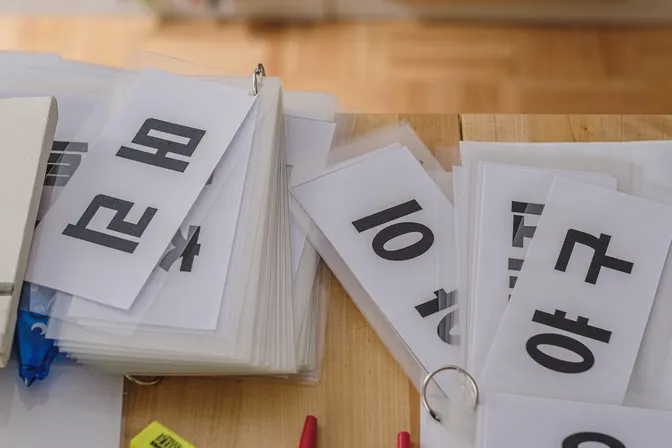
A tip before you start: the videos in this article come from our YouTube playlist on the Korean alphabet. They are taught in German, but you hear every letter pronounced, and that is the part a written article cannot replace. Reading a letter is one thing; saying it correctly from the start is another.
12 facts about the Korean alphabet
Before we start on the letters, it helps to understand what makes Hangul special. A few facts from the lesson:
- A rare kind of alphabet: Hangul is one of very few true alphabets in the world, and it was designed deliberately for one language.
- A birthday: Hangul was introduced on 9 October 1446. Korea celebrates the day as a public holiday, Hangul Day (한글날).
- Its original name: at its introduction it was called Hunminjeongeum, “the sounds for the instruction of the people”.
- Social acceptance: it was created for the lower classes of society, but the upper classes rejected it at first and held on to Chinese characters.
- Ban and comeback: Hangul was banned for a time, found its way into schools in the 19th century, and has been in general use since 1945.
- Simplicity: many Korean children can read and write Hangul before they start primary school.
- Literacy: the simplicity of Hangul is one reason literacy in Korea is close to universal.
- Use abroad: in the city of Bau-Bau in Indonesia, Hangul has been used to write Cia-Cia, a language spoken by around 80,000 people.
- Pop culture: the South Korean series “Deep Rooted Tree” is based on the creation of Hangul.
- A missing book: of the two 15th-century books that describe the creation of Hangul, one is still lost.
- Hanja: Chinese characters, known as Hanja, are rarely used in Korea today.
- The keyboard: the Korean keyboard layout is designed so that Hangul can be typed quickly.
If you want to know more about how Hangul came into being, have a look at the history of the Korean script.
The Korean alphabet at a glance
Hangul has 24 letters: 10 basic vowels and 14 basic consonants. From these, further double vowels and double consonants are formed. The letters are never written on their own; they are always combined into syllable blocks.
Vowels and consonants. Vowels and consonants are the building blocks of every syllable. A vowel lets the air flow freely through the mouth. A consonant stops or narrows that flow, and that is what creates its sound.
How syllables are formed. Every syllable combines consonants and vowels in a fixed arrangement. What the block looks like depends on how many letters it holds and which vowel sits in it.
The placeholder. A syllable with no consonant sound at the start still needs something in that position. That is the job of ㅇ, which is silent at the start of a syllable.
The final consonant, or batchim. Some syllables end in one or two consonants, called batchim (받침). They always sit at the end of the syllable and change the shape of the block.
The eight steps to learning Hangul
We teach the Korean alphabet in eight steps. The method starts with the foundation: the basic vowels and basic consonants, and how they combine into syllables. Once that sits, we move on to the double vowels and double consonants. At the end we look at the final consonant, the batchim, and at the liaison rule that governs how syllables flow into each other.
Step 1: the ten basic vowels

| Vowel | Pronunciation | Example |
|---|---|---|
| ㅏ | a | a as in "father" |
| ㅑ | ya | ya as in "yard" |
| ㅓ | eo | between a and o, close to the o in "song" |
| ㅕ | yeo | close to the "yaw" in "yawn" |
| ㅗ | o | a plain, rounded o, as in "oh" |
| ㅛ | yo | yo as in "yogurt" |
| ㅜ | u | oo as in "moon" |
| ㅠ | yu | yu as in "you" |
| ㅡ | eu | a sound of its own, with no English equivalent |
| ㅣ | i | ee as in "see" |
1. ㅏ: a
This vowel is your friend. It sounds like the a in “father”. No surprises here.
2. ㅑ: ya
Your first glide. Say a quick “i” followed by an “a”, and you have “ya”, as in “yard”.
3. ㅓ: eo
This one takes a little practice. It sits somewhere between an a and an o. The vowel in “song” gets you close.
4. ㅕ: yeo
Another glide. This time the “i” is combined with the tricky ㅓ from above. The result is close to the “yaw” in “yawn”.
5. ㅗ: o
A plain, rounded o, without the glide that English often adds at the end. Simple and straightforward.
6. ㅛ: yo
A glide again. Combine the “i” with the plain o, and you get “yo”, as in “yogurt”.
7. ㅜ: u
Like the oo in “moon”. Nothing confusing here.
8. ㅠ: yu
The last of our glides. Put an “i” in front of ㅜ and you have “yu”, as in “you”.
9. ㅡ: eu
Now it gets interesting. This sound has no English equivalent. Place your tongue as for ㅜ, but spread your lips instead of rounding them. It is also used often in words from other languages that do not end in a vowel.
10. ㅣ: i
Finally, ㅣ. It looks like an i and sounds like the ee in “see”.
Summary: basic vowels
- Glides: ㅑ, ㅕ, ㅛ and ㅠ are made by combining two vowel sounds quickly, starting with a short “i”.
- A unique sound: ㅡ has no English counterpart and often appears in loanwords that end in a consonant.
- Pronunciation: the pronunciation can vary from vowel to vowel. ㅓ, for example, lies between an e and an o, or between an a and an o.
Step 2: the fourteen basic consonants
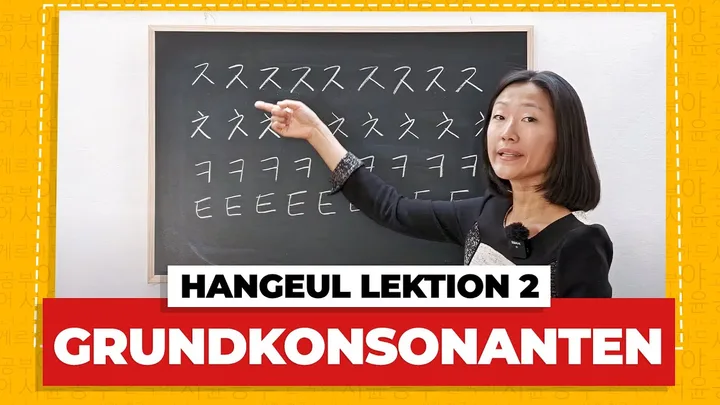
| Letter | Sound | Example |
|---|---|---|
| ㄱ | k/g | k in "skirt", g in "go" |
| ㄴ | n | no |
| ㄷ | t/d | t in "style", d in "dog" |
| ㄹ | r/l | a light r, close to the tt in American "water"; l at the end of a syllable |
| ㅁ | m | man, mother |
| ㅂ | p/b | p in "spy", b in "bass" |
| ㅅ | s | bus, sometimes sh as in "ship" |
| ㅇ | -/ng | song, ring |
| ㅈ | j/t | j in "jam", ch in "child" |
| ㅊ | ch/t | chili, chance |
| ㅋ | k | card, king |
| ㅌ | t | tart, tea |
| ㅍ | p | park, pause |
| ㅎ | h/- | h at the start of a syllable, silent at the end |
1. ㄱ: k/g
A chameleon. Depending on where it stands in a word, it sounds more like a k or more like a g. This is one reason we start with Hangul and not with romanization: one letter can carry more than one sound.
2. ㄴ: n
The familiar n, as in “no”. The tongue touches the roof of the mouth, and the letter traces that shape. Simple, isn’t it?
3. ㄷ: t/d
Another double agent. As the first consonant of a word it leans toward a t; elsewhere it sounds like a d. The tongue taps against the roof of the mouth, and there is your ㄷ.
4. ㄹ: r/l
A real shape-shifter. At the start of a syllable it is a light r; at the end it is closer to an l. It can feel confusing at first, but with a little practice it settles.
5. ㅁ: m
The nasal m, as in “mother”. The lips stay closed and the air leaves through the nose.
6. ㅂ: p/b
A plosive. The lips start closed, as for ㅁ, then open and release a b or a p.
7. ㅅ: s/sh
Two faces: an s as in “bus” and a sh as in “ship”. Which one you hear depends on the vowel that follows.
8. ㅇ: silent/ng
The joker. At the start of a syllable it is silent and only holds the place. At the end of a syllable it is pronounced ng, as in “song”.
9. ㅈ: j/ch
Close to the j in “jam” or the ch in “child”. It is pronounced with more force at the start of a word.
10. ㅊ: ch
Like ㅈ, but aspirated. A little more air escapes when you say it.
11. ㅋ: k
A harder k, created by aspiration. Think of the k in “card”.
12. ㅌ: t
A t that aspiration makes harder. The same idea as ㅋ, applied to the t sound.
13. ㅍ: p
A p that aspiration makes harder. The mouth practically bursts open and releases a strong p.
14. ㅎ: h/silent
Our last consonant is the h. It can be strong, as in “hat”, or so soft that it nearly disappears.
Summary: basic consonants
- Plosives and aspiration: consonants such as ㅂ, ㅋ, ㅌ and ㅍ are plosives; the mouth opens and air escapes. Aspirated consonants release more air and sound harder.
- Nasals: ㅁ is a nasal; the lips stay closed and the air leaves through the nose.
- Position matters: ㄱ, ㄷ and ㅂ sound different depending on where they stand in a word. ㅇ is a placeholder at the start of a syllable.
Step 3: combining letters into syllables

In Hangul, vowels and consonants are always combined into syllables and never written alone. There are only three patterns:
- C+V: a consonant and a vowel
- C+V+C: a consonant, a vowel and a final consonant (batchim)
- C+V+C+C: a consonant, a vowel and two final consonants (batchim)
So every syllable has at least one consonant and one vowel. One or two final consonants can be added. More on those in step 7.
The shape of a syllable
- A square: each syllable fits into a square block.
- Flexible letters: the letters are squeezed or stretched as needed to fill it.
Where the vowel goes
- Vertical vowels: with ㅏ, ㅑ, ㅓ, ㅕ and ㅣ, the consonant and the vowel stand side by side, as in 가.
- Horizontal vowels: with ㅡ, ㅗ, ㅛ, ㅜ and ㅠ, the consonant sits on top and the vowel underneath, as in 고.
Final consonants (batchim)
- One final consonant: with a horizontal vowel, the three letters stack from top to bottom, as in 문. With a vertical vowel, the batchim takes the lower half of the block, aligned to the right, as in 길.
- Two final consonants: the four letters share the block in four equal quarters, as in 삶.
Step 4: the placeholder

Once you know how syllables are built, a question follows naturally: what happens when a syllable has no consonant sound at the start? The answer is simple. We use a placeholder, the letter ㅇ.
The two roles of ㅇ
- At the start of a syllable: ㅇ is silent. It only holds the consonant position.
- As a final consonant (batchim): ㅇ is pronounced ng.
Examples
- We always write the vowels like this: 아 야 어 여 오 요 우 유 으 이
- And never like this: ㅏ ㅑ ㅓ ㅕ ㅗ ㅛ ㅜ ㅠ ㅡ ㅣ
With that, you can see why ㅇ is treated differently depending on where it stands. It is a consonant, and it is also a clever placeholder that preserves the structure of Korean syllables.
Step 5: the double consonants
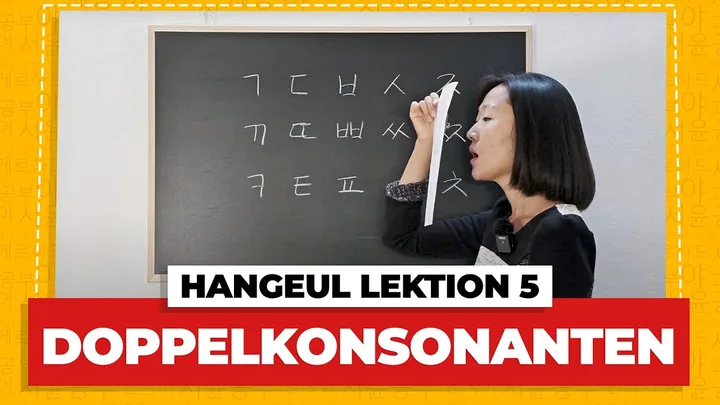
| Double consonant | Pronunciation | English example |
|---|---|---|
| ㄲ | kk/k | like the k in "sky" |
| ㄸ | tt/t | like the t in "strike" |
| ㅃ | pp/t | like the p in "spicy" |
| ㅆ | ss/t | like the second s in "sister" |
| ㅉ | jj/t | like the j in "jam" |
The double consonants are a group of Korean consonants that English does not have in this form. They are known as tense consonants.
How they differ from the basic consonants
These consonants are tense and not aspirated. They are pronounced harder and more abruptly, without any air escaping. The tongue, the glottis and the diaphragm are all tensed to produce them.
Why this matters
The distinction is essential, because the meaning of a word can change completely depending on which consonant you use:
- 사다 (sada) means “to buy”, while 싸다 (ssada) means “cheap”.
- 자다 (jada) means “to sleep”, and 짜다 (jjada) means “salty”.
- 아파 (apa) means “sick” or “it hurts”, and 아빠 (appa) means “dad”.
English does have similar sounds, such as the k in “sky” or the p in “spicy”. But English makes no conscious distinction between these sounds, so at first it is hard to tell the basic consonants from the double consonants.
How do you learn it?
Practice is the best tool. You need to develop a feel for which consonant belongs where, and that comes with time, plenty of listening, and repetition.
Summary: double consonants
- Double consonants are tense, unaspirated consonants.
- They are pronounced harder and more abruptly.
- Choosing the wrong one can change the meaning of a word completely.
Step 6: the double vowels

| Double vowel | Pronunciation | English example |
|---|---|---|
| ㅐ | ae | e as in "bed", slightly more open |
| ㅒ | yae | ye as in "yes", slightly more open |
| ㅔ | e | e as in "bed" |
| ㅖ | ye | ye as in "yes" |
| ㅘ | wa | wa as in "want" or "wine" |
| ㅝ | wo | wo as in "water" |
| ㅟ | wi | wee as in "week" |
| ㅢ | ui | no English equivalent |
| ㅚ | oe | we as in "wet" |
| ㅙ | wae | whe as in "where" |
| ㅞ | we | we as in "wet" |
Before we look at the double vowels, a short look back. You already know ㅑ, ㅕ, ㅛ and ㅠ. They are built from two basic vowels, and they gave you a first glimpse of how double vowels work.
How many there are
Hangul has 13 diphthongs in total: sounds in which two vowels are spoken in quick succession. Four of them, ㅑ, ㅕ, ㅛ and ㅠ, you have already met. The rest are the double vowels in the table, which are likewise built from two basic vowels. One detail worth knowing: ㅔ and ㅐ are written with two basic vowels, but they are not diphthongs. Each is a single sound, much like the e in “bed”.
Two ways of looking at double vowels
There are two views on what counts as a double vowel. One goes back to King Sejong, the creator of Hangul; the other comes from modern linguistics. In linguistics, a double vowel is a diphthong, two sounds pronounced in quick succession. In the original logic of Hangul, a double vowel is simply a vowel letter written with two vowel parts.
Our approach
For us, the question is not which definition is “right”. The question is what helps you learn. Some textbooks count ㅑ, ㅕ, ㅛ and ㅠ among the double vowels, because they combine ㅣ with another vowel. We teach them together with the basic vowels, because they are easier to understand there.
Step 7: the final consonant, batchim
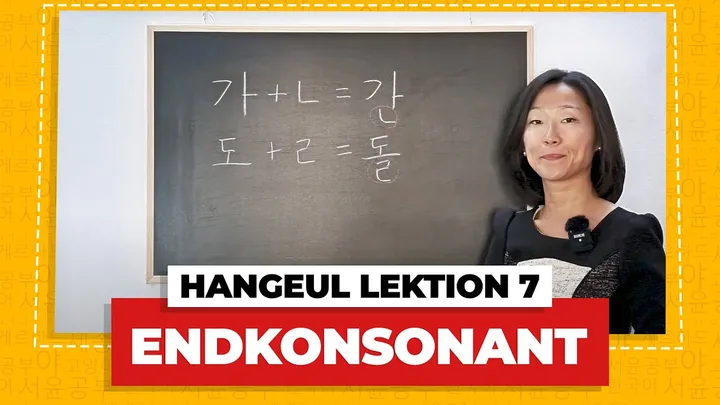
You know that every syllable in Hangul has at least one consonant and one vowel, and that one or two further consonants can be added to that pair. These final consonants are called batchim. That is what step 7 is about.
Where the batchim sits
The batchim stands at the bottom of the syllable block and adjusts to the vowel so that the block stays square. With a horizontal vowel, the batchim sits centered underneath, as in 문. With a vertical vowel, it sits under the right-hand side, as in 법.
How the batchim is pronounced
A batchim is pronounced more lightly than the same consonant at the start of a syllable. Sometimes the sound is held back almost entirely. Aspirated and tense consonants lose that quality: ㅋ and ㄲ, for example, become a plain ㄱ. That is why 박, 밬 and 밖 are all pronounced the same. In the same way, ㅅ, ㅈ, ㅊ, ㅆ and ㅎ are pronounced like ㄷ when they are a batchim, and ㄹ as a batchim is pronounced like an l.
Two batchim in one syllable
When a syllable has two batchim, they share the bottom of the block and the syllable is divided into four equal quarters.
Examples: 삶, 밖, 닭, 값, 넋
In pronunciation, only one of the two batchim is actually spoken.
| Batchim | Pronounced as | Examples | Pronunciation (transcription) |
|---|---|---|---|
| ㄲ, ㄱㅅ | [ ㄱ ] | 밖, 넋 | [박, 넉] |
| ㄹㄱ | [ ㄱ ] | 닭, 흙 | [닥, 흑] |
| ㄴㅈ, ㄴㅎ | [ ㄴ ] | 얹다, 많다 | [언따, 만타] |
| ㅆ | [ ㄷ ] | 있다 | [읻따] |
| ㄹㅂ, ㄹㅅ, ㄹㅌ, ㄹㅎ | [ ㄹ ] | 여덟, 외곬, 핥다, 싫다 | [여덜, 외골, 할따, 실타] |
| ㄹㅁ | [ ㅁ ] | 삶, 앎 | [삼, 암] |
| ㄹㅍ | [ ㅂ ] | 읊다 | [읍따] |
| ㅂㅅ | [ ㅂ ] | 값, 없다 | [갑, 업따] |
There are rules for which of the two is spoken, but you do not need to memorize them now. They settle on their own as you learn vocabulary and hear the words used.
Why the batchim matters so much
The batchim is not only a question of pronunciation. It also matters for grammar: it plays a role in verb conjugation and in many of the exceptions. The concept will stay with you well beyond the alphabet, at every step of learning Korean.
Summary: batchim
- The batchim always sits at the bottom of the syllable and adjusts to the vowel.
- A batchim is pronounced more lightly than the same consonant at the start of a syllable.
- There are special pronunciation rules, especially when a syllable has two batchim.
- The batchim also matters for grammar and conjugation.
Step 8: the liaison rule

Liaison is a French word and means “linking”. In Korean, liaison plays an important role in how consecutive syllables are pronounced. You already know that a Korean syllable has at least a consonant and a vowel, or the placeholder ㅇ and a vowel, and that one or two batchim can be added to that base.
How liaison works
Korean syllables like to begin with a consonant, but the placeholder ㅇ is not really a consonant: it is silent. So neighboring syllables often work together in pronunciation. When a syllable with a batchim is followed by a syllable that begins with the placeholder, the batchim is carried over to the next syllable when you speak.
Examples:
- 봄이 → [보미]
- 만일 → [마닐]
- 음악 → [으막]
What happens with two batchim?
When there are two batchim, the second one is carried over to the next syllable in pronunciation. Both are then spoken, rather than only one, as is otherwise the case with two batchim.
Examples:
- 앉다 → [안따]
- 읽다 → [익따]
Exceptions
There are exceptions, for instance with ㅎ. When ㅎ meets a ㄷ, the two are pronounced as ㅌ. But when a vowel follows, ㅎ is not pronounced and is not carried over to the next syllable.
Examples:
- 좋다 → [조타]
- 좋아요 → [조아요]
Liaison is one of the keys to the finer points of Korean pronunciation. It helps you sound natural, and it helps you understand what you hear.
The next steps in learning Korean
Once you have worked through the eight steps, you can read and write almost everything. But like every language, Korean has its exceptions. If you want to go into detail, there is a whole playlist on the pronunciation exceptions on our YouTube channel, taught in German, where you can go deeper and refine what you have learned.
When should you learn the exceptions?
Not right after the alphabet. In practice, you will find that you do not need these rules straight away. You pick up the correct pronunciation anyway, together with the vocabulary and grammar of the beginner lessons. For the curious, though, the rules explain why some words are pronounced differently from what you would first expect.
Time for the beginner lessons
With a solid foundation in the alphabet, you are ready for our Korean for beginners playlist. It is taught in German and contains 100 lessons that build on one another, so you can move into the language step by step.
You will learn vocabulary and grammar, and along the way you will develop a feel for the nuances of Korean.