Nervous in Korean: seven expressions and when to use them
Learn how to say nervous in Korean: 신경질적, 초조하다, 불안하다, 조마조마하다 and the heart words, and why 떨리다 and 긴장되다 are the two expressions you will actually hear in everyday life.
Everyone knows the feeling: an important appointment, a presentation, a first meeting. You are nervous. But how do you say that in Korean?
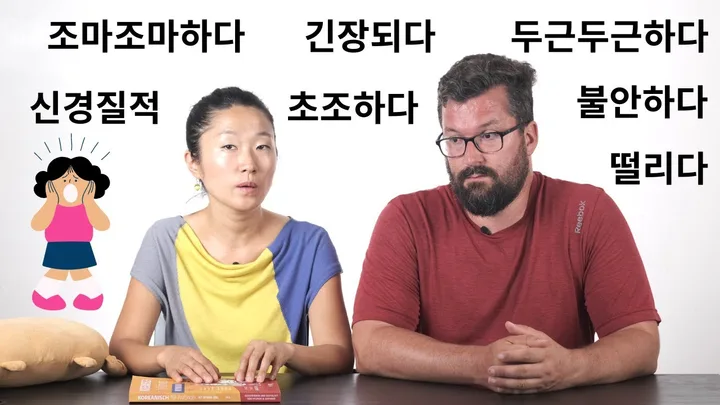
If you type “nervous” into a translation app, you get a whole list: 신경질적, 초조하다, 불안하다, 조마조마하다, 떨리다 and 긴장되다. That is confusing at first.
In this lesson, I go through these words one by one and show you which ones are actually used in everyday Korean. Two of them will do most of the work for you.
신경질적
신경질적 describes a person who gets worked up or angry easily, someone with thin nerves.
- Example: 이 사람은 신경질적이에요. (This person is nervous, in the sense of irritable.)
초조하다
초조하다 can be translated as nervous, but it is closer to worried. You use it when you are afraid of the consequences of a bad decision, when your child is late coming home from school, or when you are running late for an appointment. The feeling is concern about something that has not happened yet.
- Example: 저는 초조해요. (I am worried.)
불안하다
불안하다 is close to 초조하다, but it describes an uneasy, uncomfortable or unsettled state rather than worry about a specific outcome. 초조하다 carries concern about an uncertain future. 불안하다 simply says that the situation or mood is not calm.
- Example: 저는 불안해요. (I feel uneasy.)
조마조마하다
조마조마하다 means much the same as 초조하다, with one difference: it is about fear or uncertainty in the moment. Standing at the edge of a cliff or watching a tense scene in a film, that is 조마조마하다.
- Example: 저는 조마조마해요. (I am very nervous.)
Words that describe the heart
There are also expressions like 두근두근하다, 콩닥콩닥하다 and 벌렁벌렁하다. All of them describe a heart beating faster. They are rather poetic, and you will not hear them much in everyday conversation.
Now we come to the two expressions that Koreans use most often for “nervous”.
떨리다
떨리다 literally means to shake or tremble, and it is used often in everyday life. You say 떨리다 when a situation makes you nervous or excited: giving a presentation, for example, or being in a new relationship. I am always 떨리다 when Gerhard has to give a city tour, and I am 떨리다 whenever a new course starts with new students.
- Example: 저는 떨려요. (I am shaking.)
긴장되다
긴장되다 is used in much the same way as 떨리다, but its meaning is closer to tensing up or being tense. Together, 떨리다 and 긴장되다 are the two expressions you will hear most often for nervous in Korean.
- Example: 저는 긴장돼요. (I am tense.)
Which ones to remember
You now know seven ways to say “nervous” in Korean. For everyday use, start with 떨리다 and 긴장되다. These two capture what “nervous” usually means, and they are the ones you will hear and need first. The others you can add as you meet them.
I sometimes wonder what it says about Korean culture that we have so many words for this one feeling.