
How to send regards in Korean
Learn 안부 전해 주세요, what 안부, 전하다 and 주세요 each contribute to the sentence, and how 한테 names the person your regards are for, as in 선생님한테 안부 전해 주세요.
In this lesson we look at how to send regards in Korean: the sentence you use, what each word in it means, and how to say who the regards are for.
안부 전해 주세요.
Please send my regards.
The sentence has one noun and two verb forms. Let us take them one at a time.
What 안부 means and how it is used
안부 (Anbu) can be translated as “regards”, but the word is really about a person’s well-being, how someone is doing. When you use 안부, you are either asking after someone or letting them know that you are well. The friendly greeting is part of that.
The meaning of 전해
전해 (Jeonhae) is a conjugated form of the verb 전하다 (Jeonhada). Its basic meaning is “to pass on”, “to convey” or “to let someone know”. You use it when a message, a piece of information or a feeling has to travel from one person to another.
In 안부 전해 주세요, 전해 works together with 주세요 (Juseyo) to form a polite request. So what does 주세요 do?
Using 주세요
주세요 is the polite imperative of 주다 (Juda), “to give”. It is a versatile form in Korean, and you will often find it at the end of a sentence that asks for something.
주세요 makes a request softer and more respectful. It shows that you value the other person’s help. Combined with another verb, it means roughly “please do this for me”.
In our sentence, 주세요 turns 전해 (“pass on”) into a polite request. The whole sentence means “Please pass on my regards” or “Please ask after them for me”.
If you want to go deeper, lesson 36 of the beginner course (German) covers 주세요 in detail.

How to use 한테
Sometimes it is clear from the context who the regards are for. When it is not, you say it with 한테 (Hante). This particle attaches to a noun and adds the meaning “to”. It names the person the message or the regards are meant for.
선생님한테 안부 전해 주세요.
Please give my regards to the teacher.
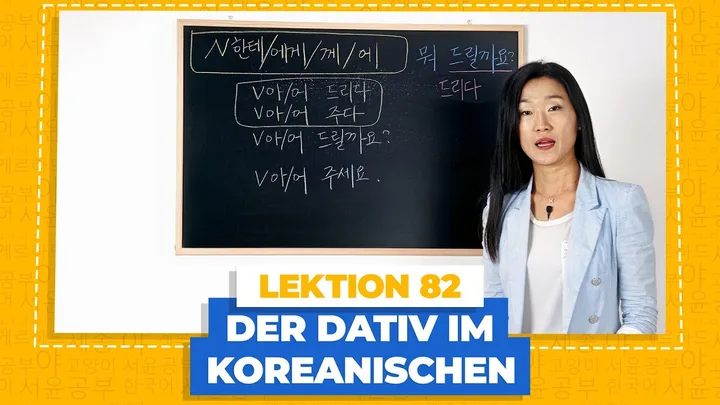
한테 is the particle that marks the recipient, what the lesson calls the dative particle. It comes a little later in the beginner course, both in the video playlist and in the book (both in German).
Summary: sending regards in Korean
Sending regards in Korean is not only a matter of politeness. It is a way of showing that you care how the other person is doing. With the sentences above, you can now pass on regards yourself or ask after someone’s well-being.