Dish with recipe
Tteokbokki
In Korean떡볶이
Tteokbokki, Hyunok's recipe
Round rice cakes in a sweet and spicy sauce of Gochujang and Gochugaru. I show you the basic recipe and what you can add: fish cake, egg, cheese, vegetables or ramen noodles.
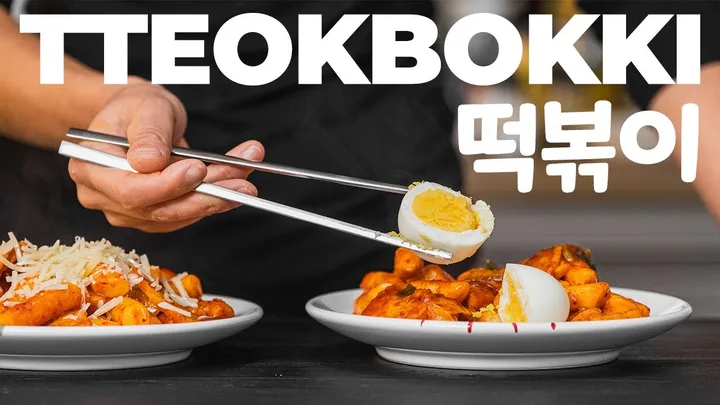
The video is in German.
About the dish
Tteokbokki (떡볶이) is the king of Korean street food: chewy, round rice cakes in a sweet and spicy Gochujang sauce (고추장). 떡 (tteok) means rice cake, 볶이 (bokki) comes from frying. Tteokbokki is not a main meal but a snack.
The rice cakes simmer in the sauce until it thickens and coats them. With fish cake (어묵) and hard-boiled eggs, Tteokbokki is the classic afternoon snack of Korean school children. It is sold at street stalls and in Bunsikjip (분식집, snack shops) all over Korea.
We like to eat Tteokbokki together with Eomuk-tang (어묵탕), which is fish cake soup, with Sundae (순대), which is Korean blood sausage, or with Twigim (튀김), which is fried vegetables or something else fried.
The modern spicy version came up in the 1950s in the Sindang-dong district (신당동) of Seoul. Today there are countless variations, for example with a cream sauce or carbonara style. If someone cannot eat spicy food, children for example, we also make Tteokbokki with soy sauce only. That is called Ganjang-Tteokbokki (간장 떡볶이).
The word 떡 is central to Korean cooking: it is part of Tteokguk (New Year soup), Tteok-galbi, Songpyeon and many other dishes.
At a glance
- Part of the meal
- Snack between meals (Gansik 간식)
- Kind of dish
- Rice cakes (Tteok 떡)
- Prep
- 5 min
- Cook
- 10 min
- Total
- 15 min
- Yield
- 2 servings
- Difficulty
- Easy
- Allergens
- Soy, Wheat, Fish, Egg
The recipe
Method
Prepare
Slice the spring onion at a slight angle. It is easier to cut that way. If you are using fish cake, cut the sheets into bite-sized pieces. Press the garlic if you want to add some.
If the rice cakes stick together, put them into cold water for a moment and separate them. You do not need to soak them.
If you would like eggs with it, boil them now for about 15 minutes. That is roughly as long as the Tteokbokki takes. I put a teaspoon of salt into the water so that the shells do not crack as they boil. Cool the eggs in cold water straight afterwards and peel them.
Cook in the sauce
Heat the pan and pour in the water. When it boils, stir in the Gochujang first, then the soy sauce and the Gochugaru. If you want it less spicy, use only half a tablespoon of Gochugaru.
Add the garlic and the sugar if you like and stir once more.
Put the rice cakes, the spring onion and, if you like, the fish cake into the pan. Cook everything until the rice cakes are soft and the sauce has reduced a little and thickened. That takes about ten minutes.
Serve
If you like, add the peeled eggs to the finished Tteokbokki and eat them with the sauce. You can let cheese melt on the hot Tteokbokki. You can also add it in the pan and put the lid on.
About the recipe
Good to know when you cook
For this recipe you need Tteokbokki-Tteok. These are rice cakes that are long and round like fingers. You have to buy them in an Asian shop. The flat sliced rice cakes are for soup.
Fish cake, eggs and cheese are optional. The cheese also makes the Tteokbokki less spicy. You can leave out the sugar and the spring onion as well. If you like, you can add other vegetables, for example finely sliced carrots, onions or white cabbage, or ramen noodles. For vegan Tteokbokki, leave out the fish cake, eggs and cheese.
The allergens above apply with fish cake and egg. Cheese adds milk.
The cooking video on this page is in German.
More to read
What do Koreans eat on Seollal (설날), New Year’s Day?
The traditional Korean New Year dish is called Tteokguk (떡국) and consists of several ingredients that you will find in many dishes of Korean cuisine and that you should know as a Korea expert.
Stainless Steel & Rice: Chopsticks in Korea
In this article, I want to tell you all about Korean chopsticks: where chopsticks originally came from, how Korean, Chinese and Japanese chopsticks differ, why Korean chopsticks are stainless steel and when Koreans start using them.
Korean Ancestor Ceremony for the New Year
Jesa (제사) is the Korean ancestral ceremony. Families hold it on Seollal, on Chuseok and on the anniversary of a death, and at the two big holidays it is called Charye (차례).
On YouTube
Rather watch than read?
Learn Korean with Hyunok Jang on our English YouTube channel. Start with Hangul and work through the lessons at your own pace.