
Dish with recipe
Tteokguk
In Korean떡국
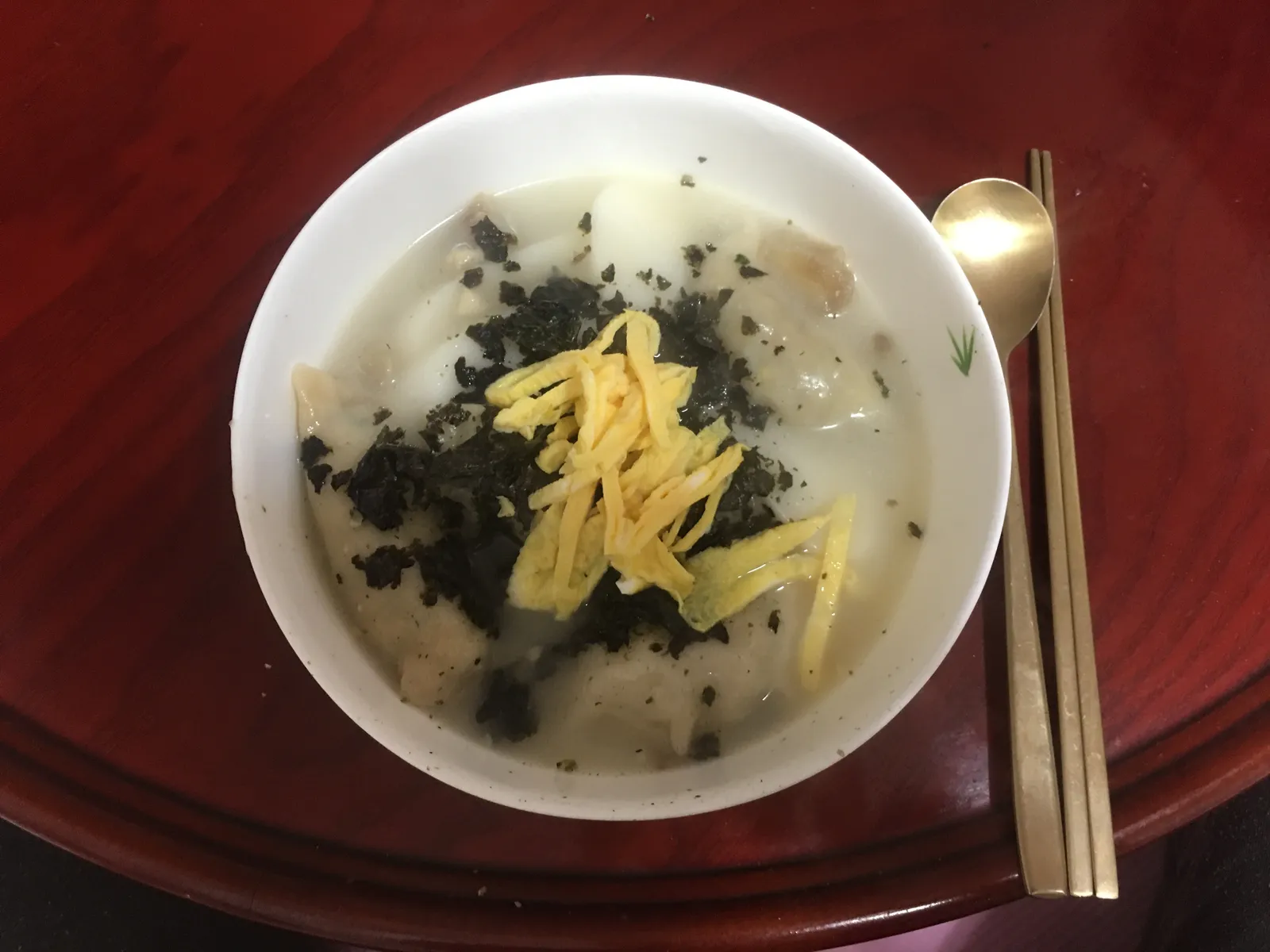
Tteokguk with anchovy broth
The rice cake soup we eat in Korea on New Year's morning, here with anchovy broth instead of beef brisket: quicker, lighter and just as common in Korea. Whoever eats it becomes a year older. That also explains how Korean age works.
About the dish
Tteokguk (떡국) is the New Year dish in Korea. At Seollal (설날, Lunar New Year) every Korean family eats this soup with oval slices of rice cake. The shape of the rice cakes (떡) recalls coins and stands for prosperity in the new year.
We eat Tteokguk on New Year’s morning. By Korean tradition you are only a year older once you have eaten Tteokguk. The soup also shows you how the language works: we say 떡국을 먹다, to eat Tteokguk, and mean becoming a year older. If you want to know how old someone is, in Korea you can also ask how many times that person has eaten Tteokguk.
The slices are cut from Garaetteok (가래떡), long sticks of rice cake. The broth is clear and light, classically seasoned with beef and soy sauce. On top lie strips of egg (Jidan), spring onions and crumbled roasted seaweed.
The word 떡 (tteok, rice cake) is essential vocabulary in Korean cooking.
If you want to understand Korean age more closely, read the article on Korean age. How Seollal is celebrated otherwise is explained under Korean New Year.
At a glance
- Part of the meal
- Main dish
- Kind of dish
- Soups (Guk 국, Tang 탕), Rice cakes (Tteok 떡)
- Prep
- 20 min
- Cook
- 15 min
- Rest
- 30 min
- Total
- 1 hr 5 min
- Yield
- 4 bowls
- Difficulty
- Easy
- Diet
- Pescatarian
- Allergens
- Egg, Fish, Sesame, Soy, Wheat
The recipe
Method
Prepare
Put the Tteok slices into a bowl of cold water and let them soak. Fresh rice cakes do not need this, but dried or frozen ones do: otherwise they turn soft outside and stay hard inside.
For the egg strips (Jidan), separate the yolks and the whites and beat each lightly. Fry them in the pan over low heat, one after the other, into very thin sheets without letting them colour. Let them cool and cut them into fine strips.
Strain the anchovy broth until it is clear. A cloudy broth tastes the same but does not look like New Year, and with this dish the look is part of it.
Cook
Bring the broth to the boil with the chopped garlic and stir in the Ganjang. Salt carefully: the anchovy broth already brings salt, and the Gim at the end brings more.
Add the drained Tteok slices and let them simmer until they rise to the surface and are soft. Try one slice: it should give, but not fall apart.
Take the pot off the heat. The soup thickens as it stands, because the rice cakes release starch. So serve it straight away rather than keeping it warm.
Serve
Divide the soup between the bowls and top it with the egg strips, the spring onions and the crumbled Gim. Yellow, white, green and black are among the five colours of the Korean table. That is why the egg lies on top separated into yolk and white.
Drizzle the sesame oil over the top at the end and, if you like, sprinkle on sesame seeds. The oil goes in at the end and not into the pot: heated, it loses its fragrance.
About the recipe
Good to know when you cook
The classic Seoul version draws its broth from beef brisket for hours. Here I use Myeolchi-Yuksu, anchovy broth. This is not a budget version: both are common in Korea. The anchovy broth is lighter and ready in twenty minutes, and for a soup eaten in the morning that is rather an advantage.
Two things matter. The rice cakes have to be soaked, or they stay hard inside. And the sesame oil only goes into the bowl, never into the pot.
On YouTube
Rather watch than read?
Learn Korean with Hyunok Jang on our English YouTube channel. Start with Hangul and work through the lessons at your own pace.